
Custom Corporate Uniforms vs. Ready-Made: 5 Critical Differences
Both options get your team into matching outfits — but they solve different problems. Here's what "custom" actually means in bulk manufacturing, and how to decide which one fits your business.
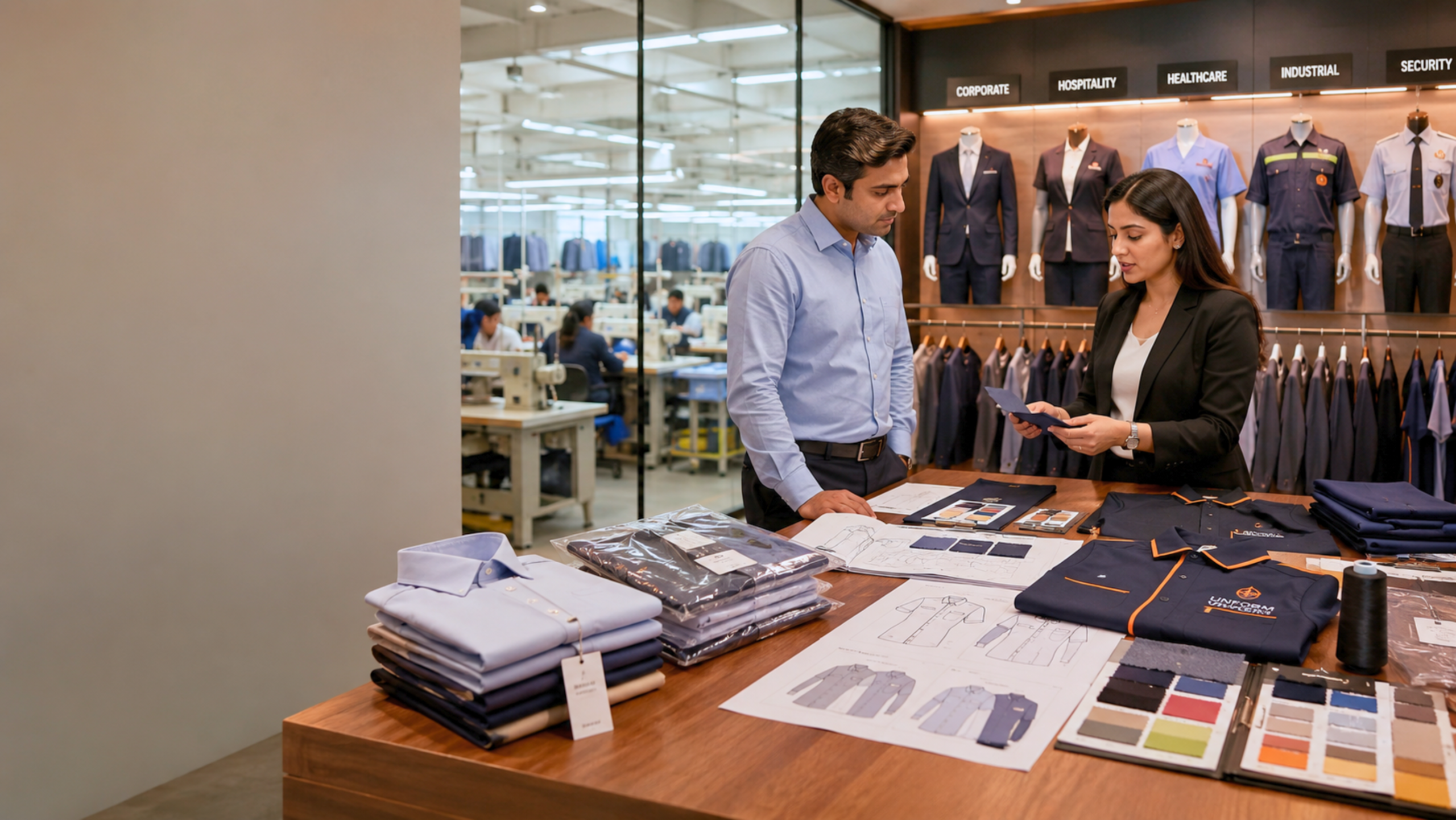
At Uniform Weavers, one question comes up in almost every consultation: should you go custom or ready-made? Businesses comparing custom corporate uniforms against off-the-shelf options usually assume "custom" is the better choice by default. But before you commit to a fully custom order, it's worth understanding what that word actually means in bulk manufacturing — because it's not what most people expect.
First, a Clarification That Will Save You Time
"Custom" in bulk corporate uniform manufacturing almost never means made-to-measure tailoring — a garment cut to each individual employee's exact body measurements, the way a bespoke suit is made. That approach doesn't scale: it's slow, expensive, and impractical once you're ordering for a team rather than one person.
What "custom" actually means for a bulk corporate uniform order:
- Your choice of fabric, colour, and design applied consistently across the order
- Logo branding — embroidered, printed, or otherwise — placed exactly where and how you want it
- Styling details like collar type, piping, contrast trims, or pocket placement
- All of this built on standard, graded sizing (S, M, L, XL, XXL, and so on) rather than individual body measurements

Ready-Made (Stock) Uniforms: What You're Actually Getting
Ready-made uniforms are pre-designed, pre-produced garments in standard colours and cuts, with little to no branding or design input from you — the opposite end of the spectrum from custom corporate uniforms. They're the fastest and cheapest way to get a team into matching uniforms.
Ready-made makes sense when:
- You need uniforms urgently, with no time for a design or sampling cycle
- The order is small or for a short-term/one-off event
- Brand-specific colours or logo placement aren't a priority
- Budget is the primary constraint, not brand consistency
Custom Corporate Uniforms: What You're Actually Getting
This is where most ongoing corporate uniform programs land — branded, consistent, designed around your company's identity, but still manufactured efficiently at bulk scale using graded sizing rather than per-person tailoring. It's also where most of our own corporate clients across Mumbai, Navi Mumbai, and Thane land once they've weighed the options. See our corporate uniform manufacturing process for how consultation, sampling, and production come together for a custom order.
Custom makes sense when:
- Uniforms are part of how your brand presents itself to clients or the public
- You're ordering on an ongoing basis, not just once
- Specific fabric, colour-matching, or logo branding genuinely matters to you
- You have (or can gather) a reasonably accurate size breakdown for your team
Custom vs. Ready-Made: Side-by-Side Comparison
| Ready-Made (Stock) | Custom (Standard-Size, Bulk) | |
|---|---|---|
| Turnaround time | Fastest — often available immediately | Longer — includes a design and sample-approval cycle |
| Cost per unit | Lowest | Higher, scales with branding complexity |
| Branding / logo | Little to none | Full control (embroidery, printing, colour-matching) |
| Fabric choice | Fixed, whatever's in stock | Selected based on your industry, climate, and comfort needs |
| Fit consistency across team | Generic sizing | Matched to your team via a size chart during consultation |
| Individual made-to-measure tailoring | Not offered | Not offered — even "custom" here means graded standard sizes |
| Best for | One-off events, urgent small orders | Ongoing corporate identity, teams of any size |
How Sizing Actually Works, If Not Made-to-Measure
This is usually the part buyers are most unsure about. In practice, a good manufacturer handles it like this:
- During the consultation stage, they take basic measurements or reference your team against a standard size chart
- Each staff member is matched to the closest graded size (S–XXL, sometimes beyond)
- The sample & approval step lets you confirm fit and finish on a real garment before the full batch is produced
- Production runs across your confirmed size breakdown, not garment-by-garment customization
This keeps a team looking visually consistent — which is often the actual goal — while keeping cost and delivery timelines realistic for a bulk order.
Questions to Ask Before You Decide
- How many people actually need uniforms, and how confident are you in their sizes?
- Is this a one-time need, or will you be reordering as staff join?
- Does your brand identity depend on a specific colour, fabric, or logo placement?
- What's your actual timeline — do you have room for a sample-approval cycle, or do you need uniforms this week?
Frequently Asked Questions
It refers to customized design elements — fabric, colour, logo branding, and styling — applied to custom corporate uniforms across a standard, graded size range, rather than individual made-to-measure tailoring for each employee.
Most bulk-focused manufacturers work with standard, graded sizing rather than per-person made-to-measure tailoring, since it keeps cost and turnaround realistic for organizations ordering in volume. If precise individual tailoring is a hard requirement, confirm this with any manufacturer upfront — not every supplier offers it, and many that focus on bulk orders don't.
Ready-made stock designs are the lowest-cost option since there's no design or branding work involved. Custom made corporate uniforms cost more, but it's usually justified for any organization where uniforms are part of an ongoing brand identity rather than a one-off need.
Manufacturers typically take basic measurements or use a size chart during the initial consultation, then match each team member to the closest standard size in a graded range — keeping fit consistent across the team while remaining efficient for bulk production.
Ready-made suits one-off events, very small orders, or urgent short-notice needs, where speed matters more than brand-specific design.
Yes — many organizations start with a smaller ready-made order and move to a fully branded custom program once their requirements and budget are clearer.
Quick Recap
Understood that custom corporate uniforms mean branding and design control, not individual tailoring
Assessed whether brand consistency matters enough to justify custom over ready-made
Checked your timeline against the sample-and-approval cycle a custom order requires
Gathered a rough size breakdown for your team before requesting a quote
Confirmed directly with the manufacturer what "custom" includes in their process
This guide is published by Uniform Weavers, a corporate uniform manufacturer based in Mumbai with over 20 years of manufacturing experience, serving corporate, hospitality, industrial, and security clients across Mumbai, Navi Mumbai, and Thane.