

Choosing a corporate uniform is not only about selecting the right colour, logo placement or garment style. The best fabric for corporate uniforms has a major influence on how employees look, feel and perform throughout the working day.
A fabric may look impressive when it is new but become uncomfortable after several hours of wear, wrinkle quickly, fade after repeated washing or lose its shape within a few months. For organisations purchasing uniforms in bulk, these problems can result in employee dissatisfaction, inconsistent brand presentation and unnecessary replacement costs.
The right corporate uniform fabric therefore depends on much more than appearance. Businesses should consider employee roles, working conditions, climate, wash frequency, garment type, expected lifespan and overall maintenance requirements before approving a fabric.
This guide explains the most commonly used fabric for corporate uniforms, where each performs best, and what HR, administration and procurement teams should evaluate before placing a bulk uniform order.
Which Fabric Is Best for Corporate Uniforms?
For many everyday corporate uniforms, a poly cotton fabric for uniforms offers one of the most practical combinations of comfort, durability, wrinkle resistance and easy maintenance.
However, there is no single fabric that is ideal for every corporate uniform. A front-office executive, field sales employee and logistics team member may all work for the same organisation but require very different levels of breathability, movement, structure and durability.
A useful starting point:
| Corporate Uniform Requirement | Suitable Fabric Direction |
|---|---|
| Everyday corporate shirts | Polyester-cotton blend |
| Hot and humid working conditions | Cotton-rich breathable blend |
| Formal corporate trousers | Polyester-viscose or TR blend |
| Corporate blazers | Structured suiting or PV/TR fabric |
| Polo T-shirts | Cotton or poly-cotton pique |
| Field employees | Durable moisture-managing blends |
| High-mobility roles | Stretch-blended fabrics |
| Premium executive uniforms | Premium cotton or suiting blends |
The right choice should be based on how and where the uniform will actually be worn.
Why Fabric Choice Matters in Corporate Uniforms
Corporate uniforms are often worn for eight or more hours a day and go through frequent washing, ironing, movement and exposure to different working environments. Fabric selection directly affects:
- Employee comfort — heavy or poorly ventilated materials become uncomfortable quickly, particularly in warmer Indian cities or for employees who spend part of their day outdoors.
- Professional appearance — a fabric that wrinkles excessively, goes limp or fades quickly reduces the professional appearance of even a well-designed uniform.
- Durability — this depends on fibre composition, yarn quality, weave, finishing, abrasion resistance, shrinkage control and garment construction, not fabric weight alone.
- Maintenance — easy-care fabrics reduce the ironing and special washing employees need to do.
- Corporate branding — fabric affects embroidery, printing, colour reproduction and the overall finish of the uniform. See our comparison of embroidery vs screen printing for uniform logos for how fabric interacts with branding method.
7 Best Fabrics for Corporate Uniforms
1. Polyester-Cotton Blend
Polyester-cotton, commonly called poly-cotton, is one of the most practical options for everyday corporate uniforms. It combines cotton’s comfort and breathability with polyester’s strength, wrinkle resistance and shape retention. Common blends include compositions such as 65% polyester/35% cotton, although the ideal ratio depends on the garment, climate and expected use.
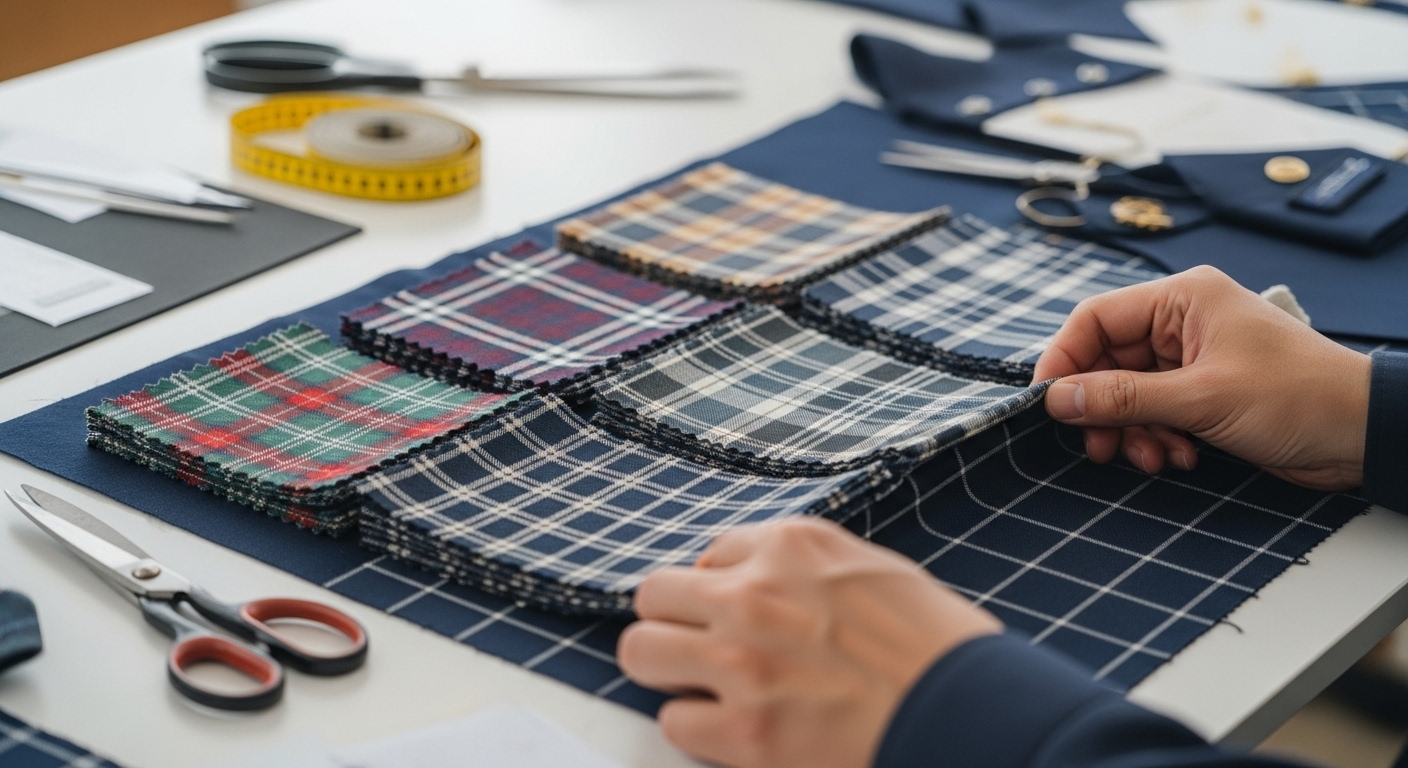
Advantages: good durability for regular wear, better wrinkle resistance than pure cotton, easier maintenance, good shape retention, suitable for embroidery and branding, dries faster than pure cotton.
Best suited for: corporate shirts, office uniforms, administrative teams, customer-facing employees, everyday staff uniforms.
Choose poly-cotton when your organisation needs a practical everyday office uniform fabric that balances appearance, comfort, durability and maintenance.
2. Cotton-Rich Blends
Cotton-rich fabrics use a higher proportion of cotton while still incorporating synthetic fibres to improve durability and maintenance. Useful when employee comfort and breathability matter most.
Advantages: softer hand feel, good breathability, comfortable for longer hours, more natural appearance than high-polyester fabrics, suited to warmer environments.
Considerations: higher cotton content can mean more wrinkling and longer drying time compared with polyester-rich fabrics.
Best suited for: corporate office shirts, client-facing employees, indoor teams, warm-weather offices, premium everyday uniforms.
3. Pure Cotton
Cotton is naturally breathable and comfortable, making it attractive where comfort is the priority. High-quality cotton can also create a premium, refined appearance.
Advantages: excellent breathability, comfortable against the skin, natural appearance, suited to warmer conditions, premium feel.
Considerations: pure cotton generally wrinkles more easily than blends and may need more ironing. Shrinkage control and colourfastness should be checked before bulk production.
Best suited for: premium corporate shirts, executive uniforms, indoor office environments, businesses prioritising natural fibres.
4. Polyester-Viscose Fabric (PV)
Polyester-viscose, often called PV fabric, combines polyester’s durability with the softer feel and drape of viscose. Particularly useful for structured corporate garments.

Advantages: good wrinkle resistance, smooth professional appearance, maintains garment structure, durable for regular use, suited to formal styling.
Best suited for: corporate trousers, formal uniforms, blazers, waistcoats, reception uniforms.
5. Terry Rayon / TR Fabric
TR blends are commonly used in formal uniform garments for their structure, drape and refined appearance. Actual performance depends on the exact fibre composition, weave and fabric weight.
Advantages: formal appearance, good drape, suited to structured garments, available in multiple finishes and textures, good balance of comfort and presentation.
Best suited for: corporate trousers, formal jackets, blazers, reception uniforms, customer-facing roles.
6. Stretch Blends
Stretch fabrics combine traditional uniform fibres with a small percentage of elastane or another stretch fibre — useful when employees need more freedom of movement while keeping a polished appearance.
Advantages: improved flexibility, greater freedom of movement, better comfort for active employees, improved fit, suited to modern fitted uniform designs.
Best suited for: field staff, sales teams, employees who travel frequently, corporate trousers, modern fitted shirts.
7. Performance Fabrics
Performance fabrics are engineered for functional benefits such as quicker drying, moisture management or improved movement — useful for employees working outside traditional office environments.
Potential advantages: faster drying, moisture management, improved mobility, lower maintenance, better suitability for active roles.
Best suited for: field teams, outdoor employees, service employees, sales staff, corporate polo T-shirts.
Corporate Uniform Fabric Comparison
| Fabric | Breathability | Wrinkle Resistance | Durability | Maintenance | Typical Use |
|---|---|---|---|---|---|
| Polyester-Cotton | Good | Very Good | Very Good | Easy | Everyday shirts |
| Cotton-Rich Blend | Very Good | Moderate | Good | Moderate | Office shirts |
| Pure Cotton | Excellent | Lower | Good | Higher | Premium shirts |
| Polyester-Viscose | Moderate | Very Good | Very Good | Easy | Trousers and formal wear |
| Terry Rayon / TR | Good* | Very Good | Good | Moderate | Blazers and trousers |
| Stretch Blend | Good | Very Good | Very Good | Easy | Active corporate roles |
| Performance Fabric | Varies | Very Good | Very Good | Easy | Field teams and polos |
*Actual performance depends on the specific composition, weave, finish and fabric weight.
Best Fabric by Corporate Uniform Type
Selecting fabric according to the individual garment is often more practical than using one material across an entire uniform programme.
Corporate shirt fabric needs to balance comfort, breathability, wrinkle resistance, professional presentation and ease of maintenance. Poly-cotton suits everyday corporate shirts; cotton-rich blends work where breathability matters more; premium cotton suits executive or premium customer-facing uniforms.
Corporate polo T-shirts are common for field employees, sales teams, corporate events and customer service teams. Suitable fabrics include cotton pique, poly-cotton pique and moisture-managing performance fabrics, depending on whether the polo is mainly worn indoors, outdoors or during active work.
Corporate trousers need good shape retention, durability and resistance to excessive creasing. Polyester-viscose, TR blends and stretch-blended suiting fabrics all work well; a controlled amount of stretch improves comfort where employees move frequently.
Corporate blazers should maintain structure while remaining comfortable for the expected wearing time — PV suiting, TR suiting, premium blended suiting or stretch suiting are all worth evaluating, with weight chosen according to climate and daily wear time.
Reception and front-office uniforms need a more structured, polished appearance. PV, TR and quality blended fabrics offer formal appearance, shape retention and consistent presentation, while comfort still matters since these employees may wear the uniform all day.
Field staff uniforms need to tolerate heat, frequent movement, travel, regular washing and varying weather. Durable poly-cotton, stretch blends and performance fabrics are worth evaluating for these roles.
Best Fabric for Corporate Uniforms in Indian Climate
India’s climate should play an important role in uniform fabric for Indian climate decisions — a fabric that performs well in one environment may not perform equally well in another.
Hot and humid conditions (coastal cities like Mumbai): prioritise breathability, moisture management, comfortable fabric weight, faster drying and appropriate fit. A very heavy or poorly breathable fabric can become uncomfortable even when it initially looks premium. For a deeper look at this specific to Mumbai, see our guide on choosing the right uniform fabric for Mumbai’s climate.
Air-conditioned offices: employees working mainly indoors can use fabrics with slightly greater structure — poly-cotton, cotton-rich shirting, polyester-viscose or TR fabrics — though commuting conditions and time spent outside the office should still be considered.
Monsoon conditions: drying time and colourfastness become more important. Look for materials that dry relatively quickly, hold colour after repeated washing, and don’t lose shape easily.
Outdoor and field roles: breathability, movement, moisture management, drying time and washability matter more than an excessively formal fabric.
How to Check Corporate Uniform Fabric Quality
Fabric should never be selected only from a photograph, catalogue or colour card. Before approving bulk production, evaluate the physical fabric and, ideally, a finished garment sample.
- Fibre composition — check the actual percentage of cotton, polyester, viscose, elastane and other fibres; two similar-looking fabrics can behave very differently.
- Fabric weight / GSM — grams per square metre indicates fabric weight, but higher GSM does not automatically mean better quality. The ideal GSM depends on garment type, climate, construction, employee role and desired appearance.
- Weave and construction — affects appearance, airflow, strength, drape, comfort and durability.
- Colourfastness — uniforms should hold colour consistently through regular use and washing, especially in a distinctive company colour. The ISO 105 series of standards is commonly referenced for colourfastness testing.
- Shrinkage — excessive shrinkage affects fit and comfort after washing.
- Pilling resistance — a uniform that pills quickly looks worn even when structurally sound.
- Abrasion resistance — should match how active the employee’s role actually is.
Fabric Quality and Garment Construction Are Different
Good fabric alone cannot guarantee a good corporate uniform. When inspecting a finished sample, also check stitch consistency, reinforced stress points, seam finishing, collar and cuff construction, button attachment, zip quality, pocket reinforcement, embroidery finish and garment fit. A premium fabric combined with poor construction can still produce a poor-quality uniform.
From Fabric Selection to Bulk Rollout: Our Experience with Mahindra Logistics
Fabric selection becomes more important when uniforms need to perform consistently across a large workforce and multiple locations. Uniform Weavers has worked with Mahindra Logistics on a corporate uniform requirement involving an end-to-end rollout across multiple sites.
For a logistics workforce, uniform decisions cannot be based on appearance alone. Employees spend long hours across offices, operational locations and different working environments, so the uniform needs to balance professional presentation with everyday practicality. Projects of this nature require attention to comfort during extended hours, fabric durability, breathability suited to working conditions, ease of washing, consistent colour across garments, branding, size and fit consistency, fabric availability for repeat requirements, and uniform consistency across locations.
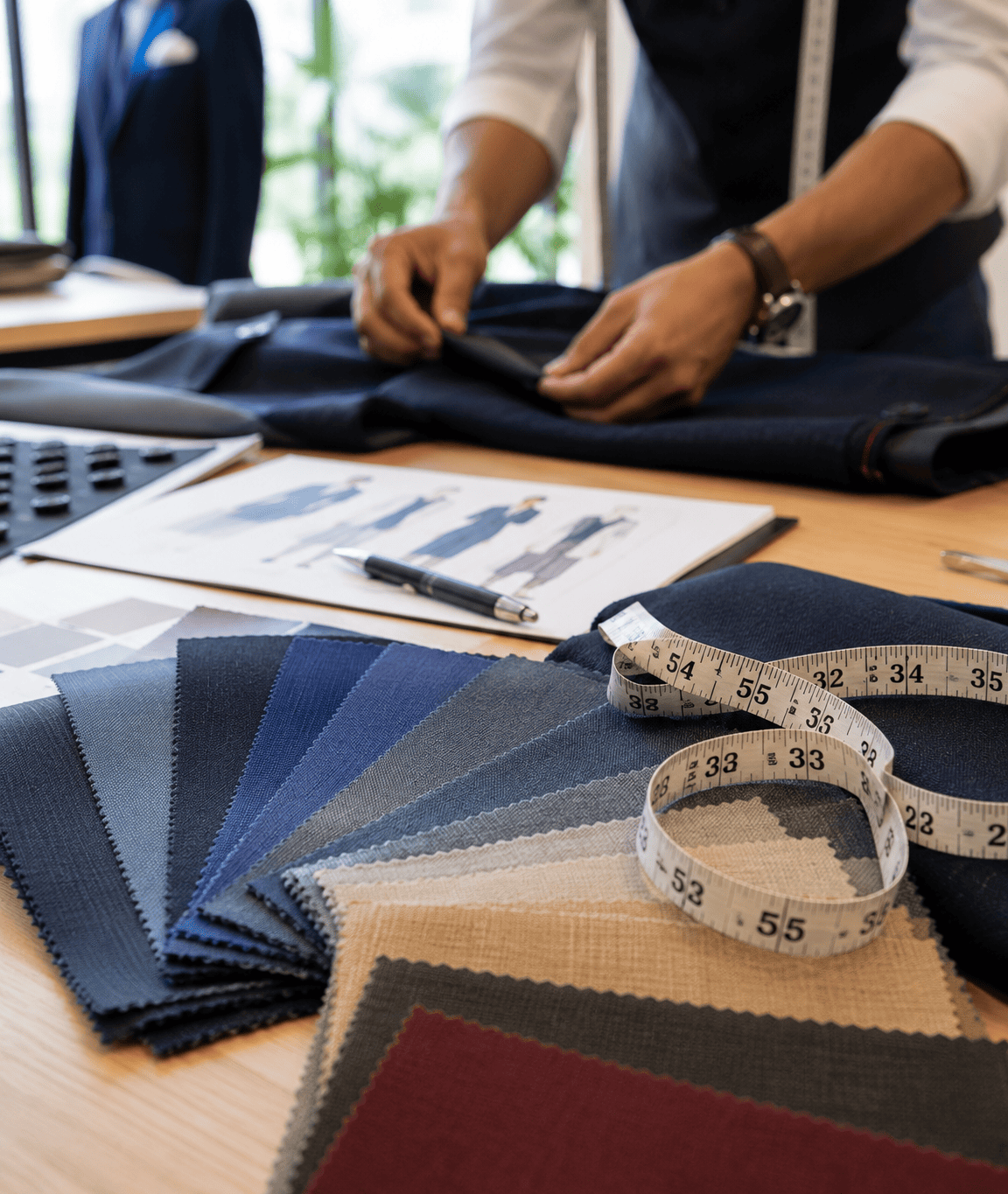
What businesses can learn from this: the best corporate uniform fabric is the fabric that matches the employee’s actual working environment, not simply the material that looks best in a catalogue. For organisations managing uniforms across large teams, fabric consistency, comfort, durability, ease of maintenance and repeat availability matter as much as colour and design. This is why the complete garment should ideally be evaluated before approving large-scale production.
As one of the corporate uniform manufacturers handling this kind of multi-site rollout, we work through fabric and design options, develop samples for approval, incorporate branding requirements, and maintain the approved specification through bulk production. See our related guide on how to place a bulk uniform order for how this process typically runs.
What We Consider When Selecting Fabric for Corporate Uniform Projects
- Employee role — a receptionist and a field sales executive need different movement, structure and performance from their fabric.
- Daily wearing hours — uniforms worn all day need more attention to comfort, breathability and fit.
- Indoor or outdoor use — outdoor roles need better airflow, faster drying and greater durability.
- Climate — temperature and humidity influence fabric weight, fibre composition, construction and design.
- Washing frequency — frequently washed uniforms need strong colourfastness, shrinkage control, durability and shape retention.
- Required corporate appearance — a consulting firm, logistics operation, service organisation and field-sales business each need a different balance of formality and functionality.
- Branding requirements — fabric should suit embroidery, printing, logo placement and corporate colours.
- Repeat availability — can the fabric be sourced consistently for new employees, replacements and future bulk requirements?
- Employee movement — employees who bend, travel or move frequently may benefit from stretch or performance fabrics.
- Budget and lifecycle cost — the cheapest initial fabric isn’t always the best value once lifespan, maintenance, replacement frequency, comfort and brand presentation are factored in.
Corporate Uniform Fabric Procurement Checklist
Before approving fabric for a bulk order, ask your supplier to confirm:
- Fabric composition
- GSM or fabric weight
- Available colours
- Colourfastness
- Shrinkage performance
- Pilling resistance where relevant
- Recommended wash care
- Suitability for embroidery and printing
- Fabric swatch availability
- Finished garment sample
- Shade consistency
- Repeat fabric availability
- Minimum order quantity
- Production lead time
- Replacement and reorder process
Avoid approving large-scale production based only on a small fabric swatch. A finished sample garment gives a much better sense of fit, comfort, drape, branding, construction and overall appearance before the final bulk order is produced.
Should One Company Use the Same Fabric for Every Employee?
Not necessarily. A common mistake in uniform planning is using exactly the same material for every role. Instead, a company can build a coordinated uniform system — front-office employees in structured shirts and formal trousers, executives in premium shirting and blazers, field sales employees in breathable shirts or polo T-shirts, and operational employees in more durable, easy-care garments. Colours, branding and design language stay consistent even when fabric specifications vary, which keeps a unified corporate identity without compromising comfort or role-specific function.
See our related piece on why corporate uniforms matter for businesses and custom vs. ready-made corporate uniforms if you’re weighing a coordinated programme against off-the-shelf options.
Common Mistakes When Choosing Corporate Uniform Fabric
- Choosing fabric only by price — the lowest-cost fabric often means faster replacement, poorer appearance, more wrinkling and employee dissatisfaction.
- Ignoring employee roles — a fabric suited to an indoor administrative employee may not perform for someone working in the field.
- Ignoring climate — heavy materials that suit cooler environments can become uncomfortable in hot, humid conditions.
- Approving fabric without a finished sample — a swatch doesn’t show how the final garment will fit, drape, feel, move or accept embroidery.
- Focusing only on appearance — a uniform must stay practical after hours of wear and repeated washing.
- Ignoring repeat availability — if the fabric can’t be sourced later, future replacement orders and onboarding may create inconsistent uniforms.
Frequently Asked Questions About Corporate Uniform Fabrics
Which fabric is best for corporate uniforms?
Polyester-cotton is one of the most practical options for everyday corporate uniforms because it balances comfort, durability and wrinkle resistance. The ideal fabric still depends on garment type, employee role, climate and desired appearance.
Is cotton or polyester better for office uniforms?
Cotton generally offers greater natural breathability, while polyester usually gives better wrinkle resistance, faster drying and durability. Many organisations choose blended fabrics to get the benefits of both.
Which fabric is best for corporate shirts?
Poly-cotton and cotton-rich blends suit most corporate shirts. Premium cotton works well for executive uniforms, and selected performance blends can suit employees working in the field.
What fabric is suitable for corporate trousers?
Polyester-viscose, TR and suitable stretch suiting fabrics work well for corporate trousers because they provide structure, durability and crease resistance.
What is the best fabric for corporate uniforms in hot weather?
Breathable cotton-rich blends, lightweight poly-cotton fabrics and selected performance fabrics all suit warmer conditions. Fabric weight, weave and garment fit matter as much as fibre composition.
What GSM should corporate uniform fabric have?
There is no single GSM suitable for every corporate uniform. It depends on garment type, climate, fibre composition, construction and employee role. GSM should not be treated as a standalone measure of quality.
Which corporate uniform fabric wrinkles the least?
Polyester-rich blends, polyester-viscose fabrics and certain performance fabrics generally resist wrinkles better than pure cotton, though actual performance depends on construction and finishing.
Should businesses request a fabric sample before placing a bulk uniform order?
Yes. Evaluating both the fabric and a finished garment sample gives a far more accurate picture of fit, comfort, drape, construction, branding and overall appearance before bulk production.
Is one fabric suitable for the entire corporate workforce?
Not always. Different roles often need different fabrics. A business can keep consistent colours and branding while varying materials across executives, office staff, field employees and operational teams.
Final Thoughts
The best fabric for corporate uniforms isn’t necessarily the most expensive or the heaviest material — it’s the fabric that performs correctly for the employees who will wear it. Before selecting a corporate uniform material, weigh employee roles, working environment, climate, comfort, wash frequency, garment type, branding requirements, durability, fabric availability, maintenance and overall lifecycle cost.
A well-planned uniform programme may use different fabrics across shirts, polo T-shirts, trousers and blazers while keeping the same colours, branding and overall corporate identity, so the uniform continues to look professional, feel comfortable and perform reliably throughout its intended lifecycle.
Planning Corporate Uniforms for Your Team?
Uniform Weavers helps businesses evaluate suitable fabric options, develop samples, customise branding and manage bulk corporate uniform requirements. Instead of choosing fabric on appearance alone, compare materials against employee roles, working conditions, climate, comfort, maintenance and expected usage.
Request Fabric Samples → or Discuss Your Corporate Uniform Requirement →
Need Help Choosing Corporate Uniform Fabric?
📍 Address: V. J, 116, Tokershi Jivraj Rd, next to Jubilee Heights, Cotton Green Zakaria B, Block Sector, Sewri, Mumbai, Maharashtra 400015
📞 Phone: +91 9167 241 341
📍 Google Business Profile