
Safety Workwear Manufacturer in Mumbai
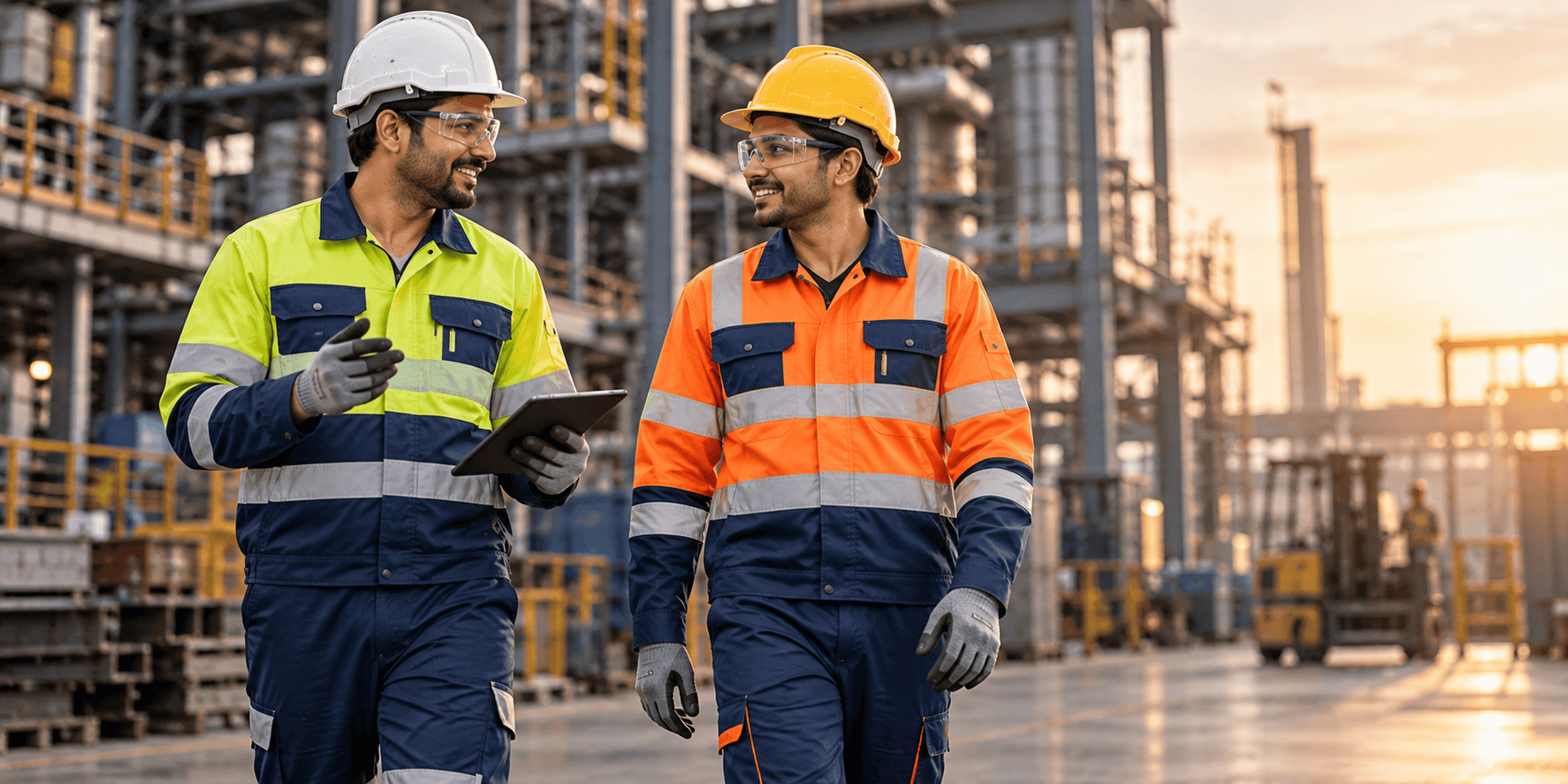
Safety workwear should start with the job—not with a catalogue.
A warehouse employee, maintenance technician, production worker and electrical team may all need different garments because they work in different environments and face different workplace requirements.
Uniform Weavers manufactures custom safety workwear for factories, warehouses, engineering companies, logistics operations and industrial teams across Mumbai, Thane and Navi Mumbai.
We develop workwear around the approved workplace requirement, including garment type, fabric, colours, pockets, visibility details, employee sizing and company branding.
Where a job requires a particular certified protective fabric or safety standard, that requirement needs to be identified and confirmed separately before production.
Minimum Order Quantity: 50 pieces
Standard Delivery: 20–25 days
Customisation: Fabric, colours, pockets, branding and role-specific detailing
Safety Workwear Should Match the Workplace
There is no single uniform that can be called the right “safety uniform” for every industrial employee.
The garment should be selected after understanding:
- What the employee actually does
- Where the employee works
- Whether the role is indoors or outdoors
- How much movement is involved
- What the employee needs to carry
- Whether visibility is important
- Whether the company has an approved PPE or garment standard
- Whether specialised protective performance is required
That distinction matters.
A standard industrial uniform and certified protective workwear are not automatically the same thing.
Custom Safety Workwear for Industrial Teams
Safety workwear requirements may arise across several industries and operational environments.
These can include:
- Manufacturing plants
- Engineering companies
- Warehouses
- Logistics operations
- Maintenance teams
- Utilities
- Automotive facilities
- Food-processing units
- Infrastructure companies
- Facility-management teams
- Technical departments
Each workplace should define what its employees actually need before the garment specification is finalised.
Workwear for Production Teams
Production employees may spend most of their shift on the plant floor.
Their uniform needs to support regular movement while giving the organisation a consistent workforce appearance.
Depending on the workplace, the requirement may involve:
- Industrial shirts and trousers
- Coveralls
- Work jackets
- Visibility detailing
- Department identification
- Company branding
The specific garment should follow the role and workplace policy.
A production uniform should not include technical features simply because they sound useful. Every feature should have a purpose.
Workwear for Maintenance Teams
Maintenance employees often move between departments, equipment areas and different working conditions throughout the day.
Their workwear may therefore need greater attention to:
- Movement
- Pocket placement
- Practical closures
- Employee identification
- Fabric
- Visibility
- Department branding
If the maintenance role has particular protective requirements, those requirements should be communicated at the start of the project.
This helps separate standard workwear features from genuine safety-performance requirements.
Workwear for Warehouse & Logistics Teams
Warehouse and logistics employees frequently walk, lift, load, unload and move between storage or dispatch areas.
Their workwear should consider:
- Comfort during movement
- Company identification
- Practical storage
- Visibility where required
- Different indoor/outdoor conditions
- Repeated use
For some teams, a simple branded shirt-and-trouser uniform may be appropriate.
For others, coveralls or visibility garments may make more sense.
The job should determine the garment—not the other way around.
Safety Workwear vs Certified Protective Clothing
This is an important distinction.
A garment can be practical industrial workwear without automatically being:
- Flame resistant
- Arc rated
- Chemical resistant
- Antistatic
- Heat resistant
- Cut resistant
- Certified high visibility
- Compliant with a particular EN, ISO, ASTM or NFPA standard
Those are specific technical claims.
If your workplace requires one of them, tell us the exact standard, fabric requirement or safety specification supplied by your EHS, safety, operations or procurement team.
The appropriate material and documentation then need to be checked for that specific order.
Uniform Weavers does not recommend treating a standard industrial uniform as certified PPE merely because it includes heavy fabric or reflective detailing.
Choosing the Right Fabric
Fabric selection should begin with the working environment.
Before deciding, consider:
Where Will the Employee Work?
A warehouse, factory floor and outdoor maintenance environment can have very different requirements.
How Long Is the Garment Worn?
Workwear may be used throughout an entire shift.
Comfort and movement therefore matter.
How Frequently Will It Be Used?
Regular workwear also needs to fit within the organisation’s normal garment-care and replacement process.
Does the Workplace Have a Technical Specification?
If your safety team has specified a particular composition, GSM, treatment or certified material, that requirement should be shared rather than substituted with a general workwear fabric.
What Does the Company Want the Team to Look Like?
Industrial workwear is functional, but employee identification and company presentation still matter.
Available fabric options can be discussed once the actual requirement is clear.
Industrial Shirts & Trousers
Not every industrial employee needs a coverall.
For many workplaces, a practical shirt-and-trouser combination may be a better everyday uniform.
These garments can be developed around:
- Fabric
- Colour
- Pockets
- Sleeve requirement
- Company branding
- Department identification
- Employee sizing
- Visibility detailing where required
The specification can vary depending on the job.
For example, a warehouse employee and plant supervisor may use the same core colours but different garment configurations.
Industrial Coveralls
Coveralls can provide a practical one-piece uniform for certain operational roles.
They are often considered for:
- Maintenance
- Engineering
- Production
- Technical teams
- Workshop environments
If your workforce requires coveralls, these can be planned alongside the broader safety-workwear program.
Explore Industrial Coveralls →
Reflective Detailing
Some workplaces require employees to be easier to see around vehicles, equipment or low-light operating areas.
Reflective detailing can be incorporated into the approved garment design where appropriate.
Placement may vary depending on the garment and internal company requirement.
However, it is important to distinguish between:
a garment with reflective tape
and
a garment certified to a particular high-visibility standard.
They are not automatically the same.
If certified high-visibility clothing is required, the exact standard should be provided and confirmed separately.
Workwear With Company Logo
Workwear can still represent the organisation professionally.
Custom branding can help identify employees, contractors and departments within a large facility.
Depending on the garment, branding may include:
- Company logo embroidery
- Printed company logo
- Company name
- Employee name
- Department name
- Role identification
Branding should remain practical and visible without interfering with the function of the workwear.
Logo size and placement should be approved before bulk production.
Employee & Department Identification
Large plants may have several teams operating together.
For example:
- Production
- Maintenance
- Engineering
- Warehouse
- Electrical
- Utilities
- Quality
- Supervisors
Uniform design can make these teams easier to identify.
This does not necessarily require eight completely different garments.
A company can maintain one overall workwear system while differentiating departments through:
- Colour
- Embroidery
- Department labels
- Approved trim differences
- Employee-name branding
- Garment type
This usually creates a cleaner, easier-to-manage uniform program.
Colour-Coded Safety Workwear
Some companies use different colours for different teams or job categories.
For example:
| Department | Example Approach |
|---|---|
| Production | Main company workwear colour |
| Maintenance | Separate approved colour |
| Engineering | Department identification |
| Warehouse | Operational colour |
| Supervisors | Subtle differentiation |
| Technical Team | Role-specific identification |
This is not a prescribed safety colour system.
The actual structure should follow your organisation’s internal policy.
Uniform Weavers manufactures according to the approved colour requirement supplied by the client.
Practical Pocket Placement
Industrial employees may need to carry small tools, identification or work essentials.
Pockets can therefore be useful—but they should be designed around actual need.
Before finalising them, consider:
- Employee role
- Tools normally carried
- Movement during work
- Garment type
- Workplace restrictions
Adding unnecessary pockets can make a garment more cumbersome without making it more useful.
The design should remain practical.
Workwear for Supervisors & Floor Managers
Supervisors may work in the same environment as production staff while also needing to be identified quickly.
The uniform can differentiate them without completely separating them visually from the workforce.
For example, a supervisor may use:
- A different shirt colour
- Distinct department embroidery
- Alternative trim
- A different garment combination
while keeping the core company workwear colours and branding consistent.
Safety Workwear for Mixed Workforces
Industrial teams may include both men and women.
A consistent uniform program does not require forcing every employee into exactly the same garment proportions.
The workforce can maintain consistency through:
- Fabric
- Colour
- Branding
- Department identification
- Design language
while sizing and garment specifications are developed appropriately for the wearer.
The objective is one recognisable workforce with practical garments for the people wearing them.
Build the Uniform Around the Job Role
A useful industrial-uniform structure may look like this:
Production Team
Industrial Shirt + Trouser
Maintenance Team
Coverall
Warehouse Team
Industrial Workwear + Visibility Detailing where required
Engineering Team
Role-specific Workwear
Supervisor
Coordinated Uniform with Clear Identification
Outdoor / Low-Visibility Role
Approved Visibility Garment where required
This approach is more useful than putting everyone into the same garment simply to simplify purchasing.
Bulk Safety Workwear Manufacturing
Industrial uniform programs can involve large numbers of employees across different departments and shifts.
At that scale, consistency becomes essential.
Once the sample is approved, the bulk order should remain aligned across:
- Fabric
- Colour
- Garment specification
- Pockets
- Closures
- Branding
- Department identification
- Reflective details
- Employee sizes
- Finishing
Uniform Weavers handles custom and bulk safety-workwear requirements starting from 50 pieces.
For larger organisations, sharing the staff count and department breakdown early makes the project much easier to plan.
Our Safety Workwear Ordering Process
1. Tell Us About the Workplace
Start by sharing:
- Industry
- Number of employees
- Job roles
- Departments
- Working environment
- Current uniforms
- Delivery location
If you already have an approved garment or technical specification, share that too.
2. Define the Requirement by Role
We look at what each employee group actually does.
This determines whether the requirement is best suited to:
- Shirts and trousers
- Coveralls
- Visibility workwear
- Other approved industrial garments
3. Identify Any Mandatory Safety Standard
If your organisation requires a particular protective standard, this needs to be identified clearly.
Provide the technical requirement supplied by your safety or procurement team.
This prevents a standard uniform from being incorrectly treated as certified protective equipment.
4. Discuss Fabric & Design
Once the operational requirement is clear, suitable garment and fabric options can be considered.
The design can also cover pockets, closures, colours and visibility details.
5. Finalise Branding & Identification
Company logos, department names and employee identification are approved before production.
6. Sample & Approval
The sample should be reviewed in the context of the job.
Check:
- Comfort
- Movement
- Fabric
- Pockets
- Closure
- Branding
- Visibility details
- Overall sizing
before moving to the complete order.
7. Finalise Sizes
Employee sizing is coordinated before manufacturing.
Uniform Weavers does not provide an on-site measurement service, so sizing is handled through the agreed size information and sample-approval process.
8. Bulk Production
Once approved, production begins according to the finalized specification.
9. Quality Check & Delivery
The completed order is checked against the approved requirement before dispatch.
Standard delivery is generally 20–25 days, subject to quantity, garment mix, fabric, customisation, approvals and production requirements.
Safety Workwear in Mumbai
Uniform Weavers manufactures custom safety workwear for factories, warehouses, engineering businesses and operational teams across Mumbai.
The requirement can range from one standard industrial uniform to a larger workforce program covering several departments.
Explore Industrial Uniforms in Mumbai →
Safety Workwear in Thane
Industrial companies across Thane can discuss custom workwear requirements including garment type, fabric, colours, branding, department identification and bulk production.
Uniform Manufacturer in Thane →
Safety Workwear in Navi Mumbai
Uniform Weavers also works with industrial and logistics organisations across Navi Mumbai requiring customised workwear for operational teams.
Uniform Manufacturer in Navi Mumbai →
For requirements outside these areas, share the delivery location while requesting a quotation so fulfilment can be confirmed.
Building a Complete Industrial Workwear Program?
Safety workwear may involve several different garments.
Your broader requirement may include:
- Industrial Shirts & Trousers
- Industrial Coveralls
- High-Visibility Workwear
- Maintenance Uniforms
- Warehouse Workwear
- Supervisor Uniforms
- Role-specific protective garments where documented
A stronger procurement approach is to first map:
Department → Job → Environment → Garment requirement
and then design the uniform program around those needs.
What to Send Us for a Safety Workwear Quote
Where possible, share:
- Approximate quantity
- Industry
- Employee roles
- Departments
- Working environment
- Garments required
- Preferred fabric or approved specification
- Colour requirements
- Pocket requirements
- Employee sizes
- Company logo
- Department identification
- Reflective-detail requirement
- Required safety standard, if applicable
- Delivery location
- Existing garment or reference design
If some details are still being finalised internally, that is fine.
They can be resolved before the sample and production stages.
Safety Workwear Order Information
Minimum Order Quantity
50 pieces
Standard Delivery
20–25 days
Customisation
Fabric, colours, pockets, garment styling, branding and department identification according to the approved requirement
Company Branding
Embroidery or printing depending on the garment
Reflective Detailing
Can be discussed where required
Special Protective Requirements
Must be specified, verified and agreed separately
Sampling
Approval before bulk manufacturing
Sizing
Coordinated through the agreed sizing process
Primary Service Areas
Mumbai, Thane and Navi Mumbai
Order Type
Custom and bulk industrial safety-workwear requirements
Frequently Asked Questions About Safety Workwear
What is the minimum order quantity for safety workwear?
The minimum order quantity is 50 pieces. For larger industrial orders, share your workforce and department breakdown while requesting a quotation.
What types of industrial safety workwear do you manufacture?
Requirements can include industrial shirts and trousers, coveralls, visibility garments and other workwear developed according to the approved workplace specification.
Can you add our company logo?
Yes. Company branding can be added through embroidery or printing depending on the garment and approved design.
Can different departments use different colours?
Yes. Department-wise colour coding can be incorporated where the organisation already uses or approves that system.
Can reflective tape be added to workwear?
Reflective detailing can be discussed as part of the approved garment specification.
However, a garment with reflective tape should not automatically be treated as certified high-visibility clothing unless the relevant standard has been specified and verified.
Is all your safety workwear flame resistant?
No. Standard industrial workwear should not automatically be considered flame-resistant.
If FR clothing is required, provide the exact required fabric and safety standard so the appropriate specification and documentation can be confirmed separately.
Can you manufacture workwear for chemical plants or electrical environments?
We can discuss the garment requirement, but any specialised chemical, electrical, arc-flash, antistatic or other protective specification needs to be clearly identified and technically confirmed before manufacturing.
Can employee names and departments be embroidered?
Yes. Employee or department identification can be included where required.
Can you manufacture for both men and women?
Requirements can be developed for mixed workforces while maintaining a coordinated company appearance.
How long does a bulk safety-workwear order take?
Standard delivery is generally 20–25 days, subject to quantity, garment type, fabric, customisation, sample approval and production requirements.
Do you provide a sample before bulk manufacturing?
Yes. The sample and approval stage establishes the agreed garment specification before the complete bulk quantity proceeds.
Do you provide on-site employee measurements?
No. Uniform Weavers does not currently offer an on-site measurement service. Sizing is coordinated through the agreed size information and sample-approval process.
Do you manufacture safety workwear in Mumbai?
Yes. Mumbai is one of Uniform Weavers’ primary markets, along with Thane and Navi Mumbai.
Looking for Safety Workwear for Your Workforce?
Start with the work your employees actually perform.
Tell us your industry, job roles, working environment, approximate quantity, garment requirements, branding and any mandatory workplace specifications.
From there, the appropriate workwear design and sample can be developed before bulk production begins.
MOQ: 50 pieces | Standard Delivery: 20–25 days